First Edition · $67 → $37  ★  Your price is held for --:--:--

From the @AmosRoweOzark channel

How long would your family last
with no one coming?

The Ozark Frontier Record — the long-lost skills that kept one Ozark family fed, warm and safe through droughts, blackouts and a Depression that emptied half the country's tables. Every method sourced. Every claim you can check. Instant PDF download.

✓ 7-day money-back promise ↓ Instant PDF download
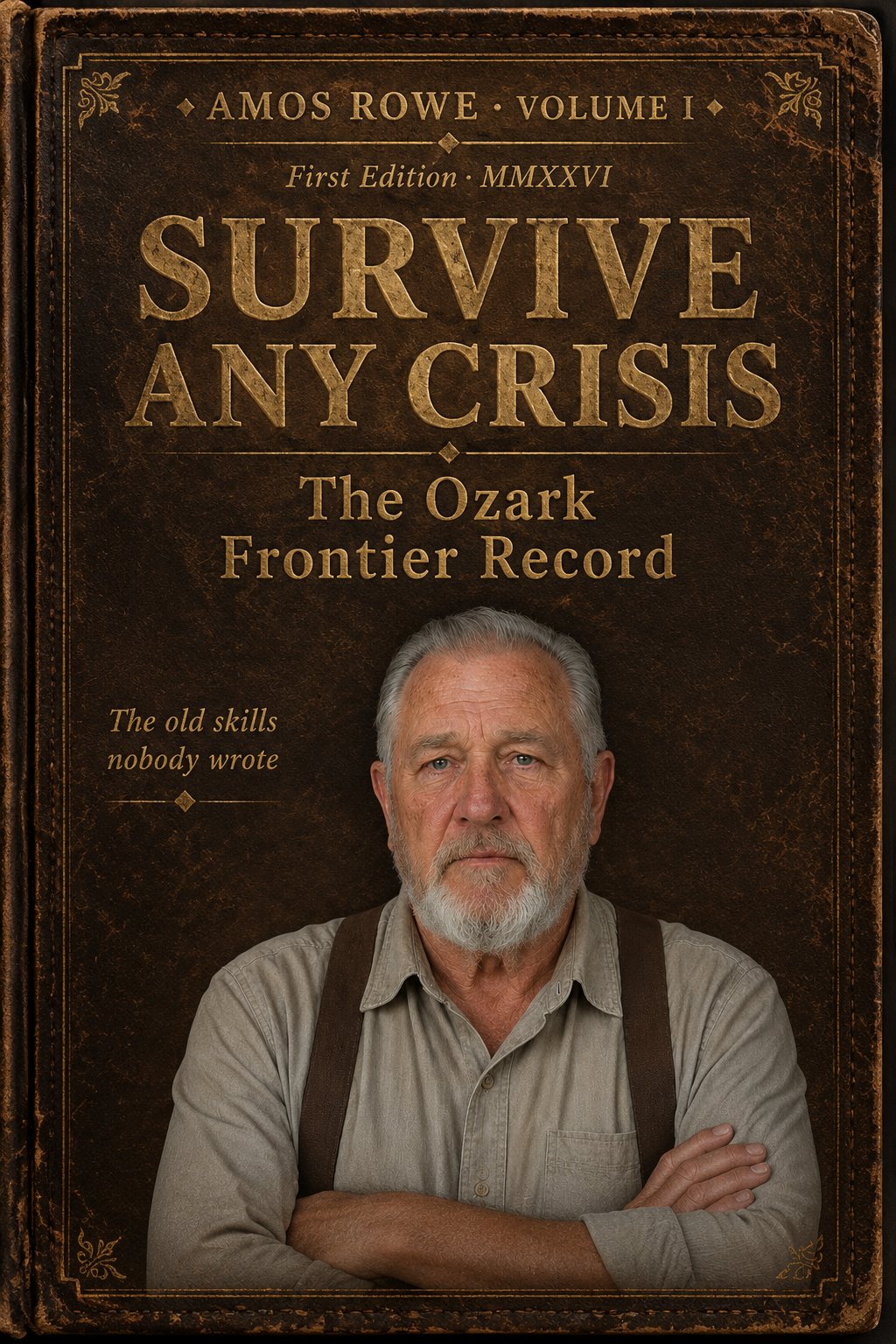
The Ozark Frontier Record by Amos Rowe — First Edition MMXXVI
Every oneDocumented & sourced
14Sections, shelter to bench
1930s–1970sEra covered
I. The Three-Day Country

How long would your family
last with no one coming?

Count it. FEMA's own emergency guidance says three days: the minimum every household is told to keep on hand, for exactly the kind of week nobody sees coming. A grocery store doesn't keep much more behind the register — it restocks by the truckload, not from a warehouse out back. When the trucks stop, so does the food on those shelves. After that, you are standing in a parking lot with a thousand other people who also just figured out somebody else had a plan.

That is not a hurricane, a war, or a headline. That is one storm, one blackout, one bad week at the stores — and the arithmetic does not care which.

Your great-grandparents never worried about any of this. Not because their lives were easier — they were harder — but because they knew how to do things. They came through plagues, droughts, and a Depression that emptied half this country's tables, with no generator, no gadgets, and nobody coming to help.

I am the last man in my family who was taught these things by somebody who did them. My own children were not. That is why this exists.

Then we let all of it die with them. One generation. That is all forgetting takes.

II. Introducing the Record

The Ozark Frontier Record

The skills one Ozark family kept between them — written down before the last man who was taught them ran out of time.

This is not a history book. There is no nostalgia in it and no photographs of anybody's grandmother.

It is a record. Every chapter runs the same shape: what it was, how it is done, the exact method with the numbers in it, the two ways people get it wrong, and where the line is that you should not cross without somebody who knows more than me.

Where the old way is better, it says so. Where the old way was wrong — and a good deal of it was wrong, particularly about meat and about jars — it says that too, and tells you what we know now instead.

III. What's Inside

Fourteen things they knew that you don't.

Every section is a skill your great-grandparents had that never made it to you — shelter, fire, food, water, tools — written the same way every time: what it was, how it was done, and where the line is.

Section 1

Shelter

Warmth · Dry · No power needed

"Four ways to stay warm and dry with nothing built for the job."

Section 2

Fire & Heat

Heating · No furnace

"Heat the room, not the house. That was the whole trick."

Section 3

Water

Finding it · Keeping it safe

"Spring, well and cistern. Nobody up our hollow ever paid for a drink."

Section 4

Wild Food

Foraging · With warnings

"The woods set a free table for them that knew what to take."

Section 5

The Cellar

Winter food · No power

"What the garden gave in July, we ate in February."

Section 6

Salt & Smoke

Meat · With warnings

"One hog, done right, carried eight people to spring."

Section 7

The Jar

Preserving · Any season

"A jar that seals is a meal. One that doesn't is a warning."

Section 8

When the Power Goes

Blackout basics

"Light, heat and a hot meal, with no plug in the wall."

Section 9

The Quiet Pantry

Old-school stores

"A pantry that outlasts a bad year, built one grocery run at a time."

Section 10

Keeping What's Yours

Storage · Out of sight

"Every house had a place nothing valuable ever sat in plain view."

Section 11

The Bench

Tools · No hardware store

"A good tool, kept sharp, outlived the man that bought it."

Section 12

Mending

Fixing · Not replacing

"We fixed it, turned it, or wore it out. New was the last resort."

Section 13

Fat & Soap

Cleaning · From scratch

"Hog fat and wood ash made every bar the house ever used."

Section 14

When to Stop

The limits · Read this one

"Every job in here where the right answer is to call somebody."

IV. A Closer Look

Three of them, up close

Every method is written the same shape: what it was, how it was done, with the numbers in it — and exactly where the line is you should not cross.

Section 5The CellarIn full

Cold storage with no cellar and no current

  • The two temperature bands that decide everything, and which crops belong in each
  • The north closet, the stairwell and the unheated garage — three cellars for a house that has none
  • Which vegetables must never be stored beside apples, and the reason it ruins them
  • Curing before storing: the step most people skip, and what it costs them by January
Mind yourself Storage is not preservation. This section names the crops that must be canned or frozen instead, and the signs that mean the whole crate goes out.
Section 7The JarIn full

Why jars fail, and the four reasons it is never the lid

  • Headspace, rim, ring and reheat — the four failures, in the order they happen
  • How to read a seal by hand and by ear, and what a false seal sounds like
  • The foods that changed category since your mother's day, and why the old chart is wrong on them
  • What to do with a jar you are not certain of — the answer is short and it is not "taste it"
Mind yourself Where this book and your state extension service disagree on a processing time, follow the extension service. It is in here in plain print, in every chapter it touches.
Section 4Wild FoodIn full

The free table — and the warnings that matter

  • Six plants that grow along most American fence rows and sell by the pound in a store
  • For each one: the lookalike that will hurt you, and the single feature that tells them apart
  • The season, the part of the plant, and the preparation — all three have to be right
Mind yourself This is the shortest section in the book and the most careful. It is sorted into verified, likely, and leave it alone — and there is no mushroom chapter, on purpose.
V. Where It Comes From

Nobody handed her a chart

Amos Rowe
Amos Rowe
Stone County, Arkansas · Millwright, 41 years

My father lost the sawmill in the spring of 1968. I was thirteen years old. There were six of us children, and nobody was coming — no check, no program, no neighbour with more than we had.

What we had was a garden, a hog, a milk cow, the woods behind the house, and a cellar that had to carry eight people from November to April. That first winter it carried us. Not because we were tough. Because my mother knew things.

She knew the salt-to-water ratio that keeps meat through a warm spell. She knew which weed in the fence row is food and which one looks just like it and is not. She knew why a jar seals and why it fails. Her mother showed her, in a kitchen, the way it had always been done.

This record is that, written down — and then checked. Where the old way holds up against what we know now, it says so and gives you the method. Where the old way was wrong — and a good deal of it was wrong, particularly about meat and about jars — it says that too, and gives you the tested procedure instead. There is no chapter in here that asks you to trust me over a laboratory.

Old methodsTested, not guessed
1930s–1970sEra covered
Every oneSourced or flagged
VI. You Are Covered
7

Seven days. Every dollar back.

Read the whole thing. If it is not what you expected, write to the address on your receipt inside seven days and every dollar comes back — no form, no questions, no explanation owed to anybody.

You keep the file. I am not going to chase a man for a PDF. Refunds run through Gumroad, same as the sale.

VII. Get the Record

Get the Record

One payment. The whole record, plus the tools to put it to work — on every device in the house.

The Ozark Frontier Record
The Record — every method, across 14 sections$67 value
The Salt, Heat & Time Sheet — every ratio in the book on one printable pageIncluded
The Seasonal Round — what to do in each month, one pageIncluded
The Source List — every claim in the book and where to check itIncluded
Lifetime updates — every future correction, freeIncluded
Regular price: $67
$37
First-edition price · One payment · Keep forever
Get the Record · $37
Instant download · One payment · Keep forever
VISAMASTERCARDAMEXPAYPALAPPLE PAY
VIII. Before You Buy

Before you buy

Will this actually work, or is it nostalgia?

Every method in this record is something a real household depended on, not a fact I found interesting. I did not fill it with anything I would not use myself. Whether it fits your particular house is the part I cannot promise from here — but nothing in it depends on gear you do not have or a situation more extreme than a bad week.

Is this genuine, or written by a marketing team?

Here is the promise, and it is the whole difference: no number in this manual is invented. Where a dollar figure or a temperature or a ratio appears, it is attributed to a named public source — the USDA, the Department of Energy, a university extension service — or given as a checkable current price range. The back of the manual lists every claim and where to go and check it.

Where the old way holds up against what we know now, it says so and gives you the method. Where the old way was wrong — and a good deal of it was wrong, particularly about meat and about jars — it says that too, and gives you the tested procedure instead. There is nothing in here that asks you to take my word over a laboratory's.

Do I need land, a homestead, or any experience?

No. Most of this was worked out by people who had a kitchen, a yard, and no money. There is a section on cold storage for a rented house with no basement and no permission to dig, and the shelter, mending and cellar chapters need nothing but the room you are standing in.

Couldn't I find this free on YouTube or Google?

Pieces of it, scattered and unsorted — and much of it repeated wrong from somebody who never did it. What you are paying for is that the ratios are in one place, that the ones that can hurt you are marked, and that where testing has overturned an old method this record says so instead of passing it along.

What exactly do I receive, and on what devices?

A PDF, emailed within about sixty seconds of your payment clearing, along with the three printable sheets. It reads on a phone, a tablet, a computer, or on paper. There is no subscription and nothing to cancel.

Can I print it?

Yes. It is laid out to print plainly in black and white, and the reference sheets are built for it — the salt, heat and time sheet is meant to end up taped inside a cupboard door.

What is the refund policy?

Seven days, every dollar, no questions asked. Write to the address on your receipt. You keep the file either way — I am not going to chase a man for a PDF. Refunds run through Gumroad, same as the sale.

A note on foraging and old remedies

The wild-food section is deliberately the shortest in the record and the most careful, sorted into verified, likely, and leave it alone. There is no mushroom chapter, on purpose. And there are no medical remedies in here at all — not because every old one was useless, but because I am not qualified to tell you which were, and a book cannot examine you.

The Ozark Frontier Record

They never had help coming.
They never needed it.

14 sections · Long-lost skills · Instant download

Get the Record · $37